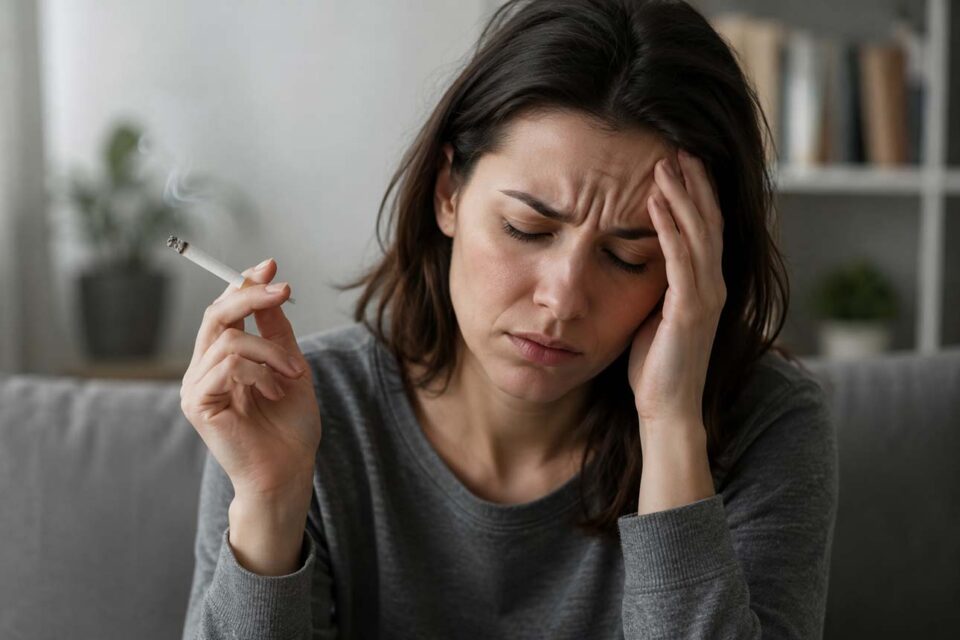
Cigarette and migraine: Why headaches can occur after quitting smoking

The relationship between cigarette and migraine is often overlooked. Yet many smokers report experiencing regular headaches, while others notice the onset of migraines or other types of headaches in the days following smoking cessation. This can be unsettling and may lead some former smokers to question whether quitting smoking is truly beneficial.

In reality, these symptoms can be explained by several physiological mechanisms involving nicotine, blood circulation and the body’s gradual adaptation to life without tobacco. Understanding the relationship between cigarette and migraine can help people navigate this transition more confidently and stay committed to their goal of quitting smoking.

cigarette fatigue stop smoking laserostop laser smoking cessation

Cigarette fatigue: why does tobacco exhaust the body more than it stimulates it?

Waking up tired despite a full night’s sleep, lacking energy from the moment you get up, or feeling constantly exhausted throughout the day: many smokers experience these symptoms without necessarily linking them to cigarettes. Yet cigarette fatigue is a very real connection.

Behind the feeling of relaxation or stimulation provided by nicotine lies a complex mechanism that gradually disrupts the body’s natural functioning. Poorer sleep quality, reduced oxygen supply, nervous tension and shortness of breath can gradually become part of everyday life.

cigarettes and tension smoking cravings and stress laserostop quit smoking

Smoking cravings and stress: why is the link between cigarettes and tension so powerful?

The connection between cigarettes and tension is deeply rooted in the habits of many smokers. During moments of pressure, the urge to smoke often appears automatically. This phenomenon, referred to as smoking cravings and stress, plays a central role in the difficulty of quitting smoking.
Understanding the mechanisms that connect cigarettes and tension makes it possible to adopt a more structured approach when facing these reactions.

world no tobacco day 2026 stop smoking quit smoking laserostop smoking cessation

World no tobacco day 2026: Unmasking the appeal of tobacco to better understand its mechanisms

World No Tobacco Day 2026 stands out as a key moment to better understand the evolving forms of attractiveness of tobacco and nicotine.

This 2026 edition is built around a strong theme: “Unmasking the appeal, addressing nicotine and tobacco dependence.” The objective is no longer limited to reminding people of the risks, but to understand why tobacco continues to attract users despite the widespread availability of information about its harmful effects.

This approach highlights a clear paradox: although the dangers of tobacco are well known, its image remains associated with ideas such as pleasure, freedom, and stress management. According to the World Health Organization (WHO), tobacco is responsible for more than 8 million deaths worldwide each year, underlining the importance of better understanding the mechanisms involved.

smoking cravings after coffee craving laserostop centre quit smoking with laserostop smoking cessation

Smoking cravings after coffee and meals: why do these urges occur so often?

For many smokers or former smokers, certain moments of the day can be particularly challenging. Among them, smoking cravings after coffee or after meals are among the most common triggers. This sudden urge to smoke can arise even in individuals who are strongly motivated to move on from tobacco.

This phenomenon is not a matter of chance. Habits linked to smoking are often built around daily rituals. Understanding why smoking cravings occur after coffee or after eating makes it easier to anticipate these situations and avoid letting them lead to a return to smoking.

dangers of vaping stop vaping laserostop stop smoking stop tobacco anti smoking laser

The dangers of vaping : an underestimated threat to health

Long presented as a more acceptable alternative to traditional cigarettes, vaping has become part of the daily lives of millions of people in just a few years. However, behind its modern image and attractive flavours, electronic cigarettes now raise numerous concerns. The dangers of vaping are increasingly the subject of repeated warnings from health authorities, medical professionals and the educational community. Respiratory effects, cardiovascular impact, exposure of young people and influence on physical performance all show that vaping is far from a harmless practice.